
Artificial intelligence is becoming a practical business tool for companies looking to improve productivity, simplify operations, and deliver better customer experiences. For businesses in the Philippines, AI presents opportunities to improve existing processes without necessarily replacing their entire technology infrastructure.
From automating repetitive administrative tasks to introducing intelligent features into websites and applications, AI-powered solutions can help businesses address operational challenges and make better use of their resources.
However, successful AI implementation requires more than subscribing to an AI platform or introducing a chatbot. It starts with understanding your business requirements, identifying suitable opportunities, and integrating the right technologies into your existing workflows.
This guide explores how Philippine businesses can adopt AI solutions, their practical applications, potential benefits, and important considerations before implementation.
What Are AI-Powered Business Solutions?
AI-powered business solutions are applications, tools, and integrated systems that use artificial intelligence to assist with tasks, process information, identify patterns, and support business operations.
Unlike traditional software that relies entirely on predefined instructions, AI can help interpret unstructured information, categorize documents, summarize content, and generate responses based on available information.
For businesses, these capabilities can be integrated into existing websites, customer relationship management systems, databases, mobile applications, and internal business platforms.
Common examples include:
- Automated customer inquiry classification.
- AI-assisted document and information processing.
- Intelligent search features within business applications.
- Automated report preparation and summaries.
- AI-assisted content production.
- Customer support response drafting.
- Workflow automation and system integration.
The objective is not necessarily to replace employees. Instead, businesses can use AI to reduce repetitive workloads and allow their teams to focus on activities that require expertise, creativity, and decision-making.
Why Philippine Businesses Should Consider AI Solutions
Businesses in the Philippines operate across industries with different technology requirements, operational challenges, and customer expectations.
Small and medium enterprises often manage multiple responsibilities with limited resources, while larger organizations may face challenges involving disconnected systems, complex workflows, and growing volumes of business information.
AI can help address these challenges when implemented around specific business requirements.
Reducing Repetitive Administrative Work
Many businesses still rely on manual processes for organizing inquiries, transferring information between systems, preparing reports, and reviewing documents.
AI-assisted automation can reduce the time spent on these activities and help improve consistency.
Improving Customer Responsiveness
Businesses receive inquiries through websites, email, social media, and other communication channels.
AI can assist with categorizing these inquiries, identifying customer requirements, preparing suggested responses, and directing requests to the appropriate team.
Human oversight remains important, particularly when responding to complex customer concerns or making business commitments.
Making Better Use of Business Information
Companies collect information through websites, applications, customer records, spreadsheets, and operational systems.
AI-powered features can help teams retrieve, summarize, organize, and interpret relevant information without manually reviewing large volumes of data.
Supporting Digital Transformation
AI implementation can complement existing digital transformation initiatives by enhancing websites, applications, and internal business systems.
Rather than introducing another disconnected platform, businesses can integrate appropriate AI capabilities into the tools their teams already use.
Practical Applications of AI in Business
The most suitable AI solution depends on the challenges a business wants to address. The following applications demonstrate how AI can support different aspects of business operations.
1. Business Process and Workflow Automation
Workflow automation helps businesses reduce repetitive manual tasks by connecting activities into structured processes.
AI can enhance these workflows by interpreting information, identifying categories, and assisting with decisions that would otherwise require manual review.
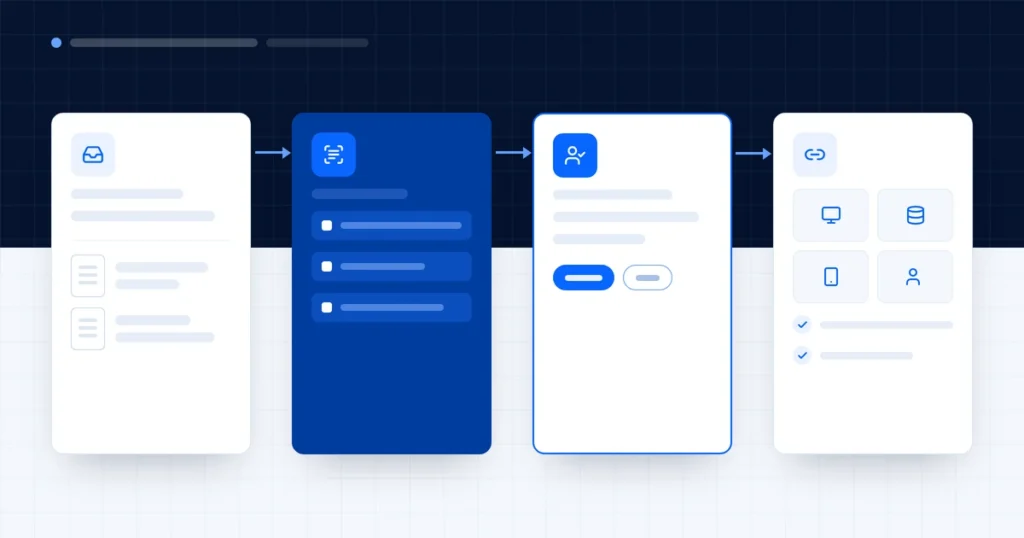
For example, a business receiving website inquiries could implement a workflow that:
- Receives a new inquiry through its website.
- Identifies the customer’s requested service.
- Categorizes the inquiry based on its content.
- Prepares a suggested response for review.
- Records the inquiry in a business management system.
- Assigns the inquiry to the appropriate team.
This approach can help streamline lead management while allowing employees to review important communications before they are sent.
Other potential applications include document routing, internal notifications, appointment requests, report preparation, and administrative task management.
2. AI-Powered System Integrations
Many businesses already use multiple digital tools to manage their operations. These may include websites, customer databases, spreadsheets, inventory platforms, accounting applications, and communication systems.
When these platforms operate independently, employees may need to transfer information manually between them.
AI-powered system integration can help connect existing technologies and introduce intelligent information processing within established workflows.
For example, an integrated solution could extract relevant information from incoming customer documents and prepare structured records for an internal business application.
Depending on the available system interfaces and permissions, AI integrations may also support:
- Customer inquiry management.
- Information synchronization.
- Internal knowledge retrieval.
- Business reporting.
- Document classification.
- Automated notifications.
A successful integration should consider data security, system compatibility, access permissions, and the reliability of automated processes.
3. AI-Enhanced Web Applications
Web applications are commonly used for customer portals, dashboards, business management systems, and internal operational platforms.
Adding AI capabilities to these applications can help users access information and complete tasks more efficiently.
Potential features include intelligent search, automated document summaries, content recommendations, natural language queries, and information extraction.
For instance, a business management dashboard could allow authorized employees to search internal records using natural language rather than navigating multiple menus and filters.
AI-enhanced web applications should be developed around the requirements of their intended users. Intelligent features should improve usability rather than introduce unnecessary complexity.
4. AI-Enhanced Mobile Applications
Mobile applications can also benefit from AI-powered features, particularly for businesses requiring convenient access to information and operational tools.
Potential applications include intelligent search, document capture, information summaries, and AI-assisted customer support.
A mobile application used by field personnel, for example, could help extract information from submitted documents or prepare summaries of recorded activities.
These features can support team productivity, provided that the application includes appropriate security controls and reliable review processes.
5. Document and Data Processing
Businesses frequently handle invoices, customer requests, forms, reports, contracts, and other documents containing important operational information.
Manually reviewing and transferring this information can be time-consuming.
AI-assisted document processing can help businesses:
- Extract information from documents.
- Categorize incoming files.
- Summarize lengthy reports.
- Organize unstructured information.
- Prepare structured data for existing business systems.
- Identify documents requiring further review.
For example, a document processing workflow could extract selected information from submitted customer forms and prepare it for staff verification before saving it to a database.
AI-generated or extracted information should be validated when accuracy is important, especially when handling financial, legal, or confidential business records.
6. AI-Assisted Content and SEO
AI can also support digital marketing, website content management, and search engine optimization.
Businesses can use AI-assisted workflows to organize keyword research, develop content outlines, identify content opportunities, prepare initial drafts, and support website optimization activities.
However, effective SEO requires more than producing large volumes of AI-generated content.
Content should be accurate, relevant, useful to its intended audience, and aligned with the business’s actual products, services, and expertise.
Human review is essential to ensure that published information meets quality standards and accurately represents the organization.
When combined with professional SEO services, AI can support research and production workflows while maintaining a structured approach to search visibility and content quality.
What Are the Benefits of Implementing AI in Your Business?
AI-powered solutions can provide several advantages when they are implemented around clearly defined objectives.
| Potential Benefit | How It Can Support Your Business |
|---|---|
| Improved productivity | Reduce time spent on repetitive administrative tasks. |
| Greater operational efficiency | Streamline workflows and information processing. |
| Faster customer response preparation | Organize inquiries and assist employees with suggested responses. |
| Better information accessibility | Help users retrieve and summarize relevant business information. |
| Connected business systems | Reduce unnecessary manual information transfers. |
| Improved scalability | Support growing workloads through appropriate automation. |
| More efficient content workflows | Assist with research, drafting, and content optimization. |
The business impact of AI depends on factors such as implementation quality, existing processes, data availability, employee adoption, and ongoing maintenance.
Businesses should establish measurable objectives instead of assuming that introducing AI will automatically improve performance.
AI Solutions for Different Industries in the Philippines
AI applications can be adapted to a wide range of industries. The following examples illustrate potential use cases rather than specific completed client projects.
Retail and E-commerce
Retail businesses can explore AI-assisted product information management, customer inquiry categorization, content production, and internal reporting.
Professional Services
Professional service providers can benefit from document organization, inquiry management, report preparation, and internal knowledge retrieval.
Manufacturing and Distribution
Businesses in manufacturing and distribution can explore document processing, internal reporting, information retrieval, and system integrations to support operational workflows.
Real Estate and Property Management
AI can assist with property inquiry classification, document organization, listing content preparation, and customer communication workflows.
Hospitality and Tourism
Hotels, travel businesses, and tourism operators can explore inquiry management, information retrieval, multilingual content assistance, and customer response preparation.
Small and Medium Enterprises
SMEs can start with focused automation projects that address recurring administrative tasks or improve existing customer inquiry processes.
The appropriate starting point depends on the organization’s requirements, operational capabilities, available information, and technology infrastructure.
What Should Businesses Consider Before Implementing AI?
Although AI offers opportunities to improve business operations, implementation requires careful planning.
Data Privacy and Security
Businesses should understand what information an AI system processes, where that information is stored, and who can access it.
Organizations handling personal information in the Philippines must consider their obligations under the Data Privacy Act of 2012 (Republic Act No. 10173) and other applicable requirements.
Sensitive customer information should not be submitted to AI platforms without appropriate authorization, safeguards, and an understanding of how the information will be handled.
Accuracy and Reliability
AI systems can produce incorrect, incomplete, or misleading information.
Businesses should establish validation processes, human review requirements, and suitable fallback procedures.
Important customer communications, sensitive transactions, and high-impact decisions should not depend entirely on unverified AI outputs.
Compatibility with Existing Systems
Not every business platform provides suitable integration capabilities.
Before introducing AI, businesses should assess whether their existing websites, applications, databases, and software can support the intended functionality.
Implementation and Operating Costs
AI implementation costs depend on project scope, integration complexity, infrastructure, platform subscriptions, usage requirements, and ongoing technical maintenance.
Businesses should evaluate the total cost of operating the solution rather than considering only its initial development cost.
Employee Adoption
Employees should understand how AI tools fit into their daily responsibilities.
Clear workflows, appropriate training, and defined review procedures can help organizations introduce AI without creating unnecessary disruption.
How to Get Started with AI Solutions for Your Business
Businesses do not need to automate every operation immediately.
A focused implementation approach can help identify practical opportunities while managing costs and operational risks.
Step 1: Identify a Specific Business Problem
Start by reviewing activities that consume significant time, create repetitive work, or involve unnecessary manual processes.
Choose a clearly defined problem rather than adopting AI simply because the technology is available.
Step 2: Review Your Existing Technology Infrastructure
Evaluate the websites, applications, databases, and business tools currently used by your organization.
Identify available information, integration requirements, and potential technical limitations.
Step 3: Define Your Objectives and Success Metrics
Determine what the AI solution should achieve.
Possible objectives include reducing document processing time, decreasing manual data entry, improving inquiry classification, or simplifying internal information retrieval.
Establish baseline measurements before implementation where possible.
Step 4: Develop a Focused Pilot Solution
Begin with a manageable workflow or application feature.
A pilot allows your team to evaluate usability, accuracy, reliability, and operational impact before expanding the solution.
Step 5: Test, Monitor, and Improve
Review the solution’s performance against its intended objectives.
Collect feedback from employees, identify issues, and refine workflows as necessary.
Expand the implementation only when the solution demonstrates sufficient value and reliability.
How Blufox Helps Businesses Implement AI-Powered Solutions
Implementing AI effectively requires an understanding of business processes, software development, system integration, and ongoing technical support.
Blufox Philippines Technologies helps businesses explore AI capabilities within their existing digital environments.
Our AI Powered Solutions include workflow automation, system integrations, intelligent application features, document processing, and AI-assisted content workflows.
By considering AI alongside website development, application functionality, SEO, and technical requirements, we help businesses identify solutions that address practical operational needs.
Our approach begins with understanding the problem your business wants to solve and determining how appropriate technologies can support that objective.
Whether you want to streamline customer inquiry management, improve existing business applications, or introduce AI-assisted workflows, the right implementation should complement your operations rather than introduce unnecessary complexity.
Frequently Asked Questions
What Are AI-Powered Solutions for Businesses?
AI-powered solutions are tools, applications, and integrated systems that use artificial intelligence to assist with information processing, workflow automation, content production, and business operations.
Can Small Businesses in the Philippines Use AI?
Yes. Small businesses can start with focused AI applications such as inquiry management, document organization, content assistance, or repetitive administrative workflows. Implementation should be appropriate to their available resources and business requirements.
Can AI Be Integrated into an Existing Website?
Yes, depending on the website’s architecture and technical capabilities. AI features can potentially be integrated into existing websites, forms, customer portals, and connected business applications.
Do Businesses Need to Replace Their Existing Software to Use AI?
Not necessarily. AI can often complement existing software through integrations and additional application features, provided the platforms support suitable interfaces and access permissions.
How Much Does AI Implementation Cost in the Philippines?
Costs vary depending on the complexity of the solution, development requirements, existing systems, infrastructure, and ongoing platform usage. A project assessment is necessary to determine an appropriate implementation scope and investment.
Is AI Suitable for Handling Confidential Business Information?
AI may be suitable for certain confidential information workflows when appropriate security controls, privacy safeguards, contractual requirements, and access permissions are established. Businesses should assess these requirements before implementation.
Can AI Improve Website SEO?
AI can support SEO research, content planning, drafting, and optimization workflows. However, meaningful SEO performance also depends on technical implementation, content quality, search intent, competition, website authority, and ongoing optimization.
Make AI Work for Your Business
Artificial intelligence can create meaningful opportunities for businesses when it is implemented around practical requirements and clearly defined objectives.
From automating repetitive processes to enhancing websites and business applications, AI-powered solutions can help organizations develop more efficient and connected digital operations.
The most effective starting point is identifying a business problem that technology can help address.
Blufox helps businesses explore practical AI implementation opportunities that complement their existing websites, applications, and operational systems.
Explore our AI Powered Solutions or contact Blufox to discuss your business requirements.
Ready to put AI to work?
Tell us which task or system you want to improve.
WORK WITH BLUFOX
Want us to handle this for your business?
Tell us about your website, app or SEO goals and we’ll recommend a practical next step.